Dr. Dimitra Chondrou, Historical Musicologist & Pianist
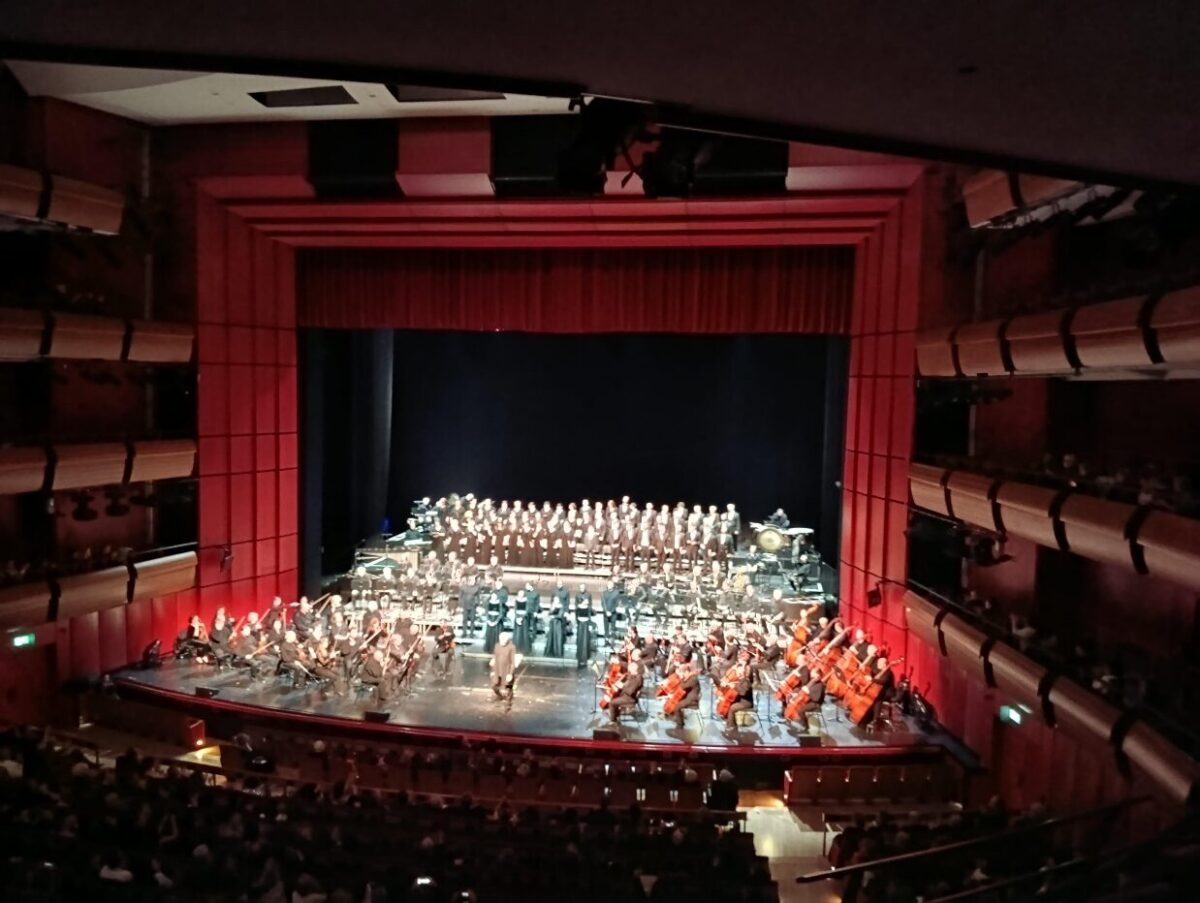
On Holy Wednesday, April 8, 2026, we attended the highly anticipated Requiem by the Georgian Vakhtang Kakhidze at the Stavros Niarchos music Hall. The work was first presented in December 2021 in Tbilisi, and due to its distinctive musical language, it was performed in Antwerp in 2023 as part of Europalia, a European artistic festival where Georgia was the honored country that year, making the work a bearer of its musical heritage.
On the stage of the Greek National Opera for this large-scale work, about 160 people were present. Apart from the Tbilisi Symphony Orchestra and the Georgian State Choir, the Women’s Chanters Quartet, the Rustavi Men’s Sextet, as well as the young soloist Dachi Glonti appeared as an integral part of the piece. On the podium was the composer himself, whom we had recently seen on the stage of the Megaron Music Hall of Athens, with the State Orchestra of Athens concert on Friday, February 20, conducting an interesting program featuring works by Stravinsky, Chopin, and Ravel (see https://www.theatromania.gr/kritiki-gia-tin-parastasi-tis-koa-stis-20-02-2026/).
The Requiem was particularly impressive because, although the composer combined elements that seemed entirely disparate, the final result was at least distinctive, reminding us that music is the Art that creates closeness among peoples, displacing any differences.
Thus, the established text of the Requiem in Latin, or Missa pro Defunctis, unfolded together with the unique polyphonic song in a local style by the female Quartet and the male Sextet-style that characterizes the traditional music of Georgia. The composer blended Western art European music with the folklore of his country, enriching the orchestration with authentic vocal timbres, while simplifying the complex traditional scales by creating a tight harmonic structure. He preserved melodies that clearly referred to ecclesiastical Gregorian chant, allowed the vocal ensembles—both monophonic and polyphonic—to develop either a cappella or with orchestral accompaniment, while the choral recitation at times added a tone of mystery. Also, the use of the entire family of percussion instruments (rhythmic and melodic) was particularly targeted, serving roles that were sometimes declarative, sometimes accompanying, or functioning as motifs de réminiscence.
Having as a morphological basis a given ecclesiastical form that in the past has been used with great success by other composers who now belong to the Pantheon of History such as Mozart, Verdi, Fauré, etc., Vakhtang Kakhidze gave it new life, transforming it into a cultural vehicle for the dissemination of contemporary music of Georgia.
At the concert, among others, the Minister of Culture of Georgia, Tinatin Rukhadze was present, who besides being a musicologist and art critic, with her institutional role as ambassador of the long-standing friendship that connects the two great cultures of our countries, presented to the Greek music-loving audience all the contributors to the performance.
Dr. Demetra Hondrou, Musicologist, Pianist, Art Critic